

You sit across from someone you like. The conversation is easy enough, and there is a moment when they look at you and you feel something begin to open. Then your phone lights up, your mind goes elsewhere, and the moment passes.
Perhaps you know that feeling from the other side of the table, too. You want to be close to someone, but you are not sure they are really there with you. Or you are a parent watching a young person you love spend hours connected to everyone and still seem so alone. Can you relate?
Not long ago, I heard evolutionary biologist Bret Weinstein say on the Jack Neel podcast that he no longer sees young people falling head over heels in love the way he once did. He said, “the head over heels in love thing, I think it vanished.” He could not explain why, and his observation left me with a question of my own.
So, is this truly the end of romantic love? In this week’s article, I want to share my perspective on that question, help you recognize what may be standing between you and the heart-to-heart connection you long for, and offer you a simple practice to begin opening your heart to love again.
The End of Romantic Love: What Is Really Happening?
Romantic love has not ended. But in a world that pulls your attention in every direction, real connection asks you to be present and willing to be seen.
Weinstein’s observation raises an important question, but it does not establish whether young people are falling in love less than they once did. The question matters, especially if you are watching someone you love struggle to find closeness, or if you recognize that struggle in your own life.
Falling in love is a mysterious thing. There is the excitement of attraction, the rush of chemistry, the longing to be close to someone. Biology has a part in that, and so do the stories about romance that you have absorbed from your family, your culture, books and films.
But there is more to love than the first spark. Your history comes with you into a relationship, as do your hopes, your wounds and your desire to be seen. Sometimes you are drawn to what feels familiar, even when it is painful. And sometimes a relationship becomes a place where you learn, heal and grow. None of that can be reduced to one explanation.
So I am not going to tell you that your phone is the reason you cannot find love. What I do want to explore is how a life full of distraction, together with the ways you protect your heart, can make it harder to see another person and allow yourself to be seen.
A World That Rarely Lets You Settle
One day in Granada, I walked out of a shop watching a news video from Venezuela and nearly walked into a stranger. She gave me a look, the same look I give other people when they do that to me. She was right in front of me, and I was somewhere else.
You may know how easily that happens. You check your phone while the kettle boils and find yourself reading about a crisis on the other side of the world. A message comes in, then a video, then another piece of news. By the time you sit down with someone you care about, your body is there, but part of your attention is still moving from one thing to the next.
The phone is not the whole problem. The pace of life, financial pressure, uncertainty about the future and the sheer amount of information asking for your attention can all leave you feeling stretched. Earlier generations had worries of their own, but today you can carry a stream of the world’s worries in your pocket from the moment you wake until you fall asleep.
Technology also brings gifts. It lets you hear the voice of someone you love across an ocean, find a community you might never have found otherwise, and learn from people far beyond your own town. The question is whether the way you use it leaves you with time and attention for the people and experiences that matter to you.
When your attention is continually pulled away, it can be harder to settle into the slower rhythm of another person. A real conversation has pauses. It asks you to listen, to notice a change in someone’s voice, and to remain there long enough for something unplanned to emerge. If your mind is already on the next notification, you may miss the moment in front of you.
When There Is Always Another Option
I have noticed another kind of overwhelm in my own work. Where I once came up with three to five article ideas, AI can now give me a hundred, and I can find myself stuck wondering which one to choose.
On a dating app, the choices are not article ideas. They are people, each with a life and a heart of their own. Yet the thought can still appear: What if there is someone better just one more swipe away?
Research shows that more choice does not affect everyone in the same way. In one dating-app experiment, more profiles brought greater feelings of choice overload; in other experiments, people choosing from a larger set were more interested in pursuing the person they selected.
The point is not that choice is bad or that you should stop using an app. It is to notice what happens inside you while you are looking. Are you getting to know the person in front of you, or are you so occupied with the possibility of someone else that you are not giving them your full attention?
As technology offers you more content and more possibilities, choosing where you give your attention matters. You cannot control every demand the world makes of you, but you can notice when another notification, video or search is taking you away from a person you care about.
And sometimes distraction offers more than something to look at. When your heart is guarded, it can also give you a place to hide from the closeness you long for.
The Heart Beneath the Distraction
There is something else worth looking at, something older than the internet. You may long to be close to someone and still feel yourself pull back when that closeness becomes possible. A person asks how you really are, and you change the subject. Someone shows interest, and you begin looking for a reason it cannot work.
A guarded heart does not appear out of nowhere. Perhaps you trusted someone who left, grew up feeling that your needs were too much, or learned that being seen could bring criticism instead of care. The protection that helped you get through an earlier experience may still be with you, even when part of you is ready for something different.
You can stay occupied, keep your options open, or have contact without revealing very much of yourself. There is no shame in recognizing this. I know how easily attention can move away from the person in front of me, and how quickly that movement can become a habit.
This does not mean every lonely person has caused their own loneliness. Circumstances, opportunity, other people’s choices and the need for safety all matter. A boundary can be wise and necessary. The question is whether a particular habit or belief is still protecting you, or whether it is keeping you from the closeness you want with someone you trust.
To See and Be Seen
A teacher of mine, Tej Steiner, developed the Five Ways of Being: Being Clear, Being Present, Being Real, Being Connected and Being Heart-Directed. I have found them helpful because they are not rules to perform. They are questions you can live with, returning to them in the middle of an ordinary day.
Being Clear can begin with asking what kind of connection actually matters to you, rather than pursuing the relationship you think you should want. Being Present means bringing your attention back to the person in front of you, even when your mind is tempted to leave. You do not have to do it perfectly. You simply notice and return.
Being Real invites you to notice what you are feeling and, when it is safe and appropriate, allow another person to see a little more of you. Being Connected asks whether you can listen beyond your judgments and meet that person as they are, rather than only as a possible answer to your loneliness. Being Heart-Directed means listening for what your heart is asking of you and letting that wisdom guide your next choice.
Consider a conversation with someone you trust. You put your phone away, listen without preparing your answer, and share something true that you might ordinarily keep hidden. Perhaps they do the same. Nothing dramatic has to happen, but for a moment you are both there. That is a different experience from being in contact while remaining out of reach.
The longing beneath romantic love is often also a longing to belong, to be known and to share your life. That longing can be met in different kinds of relationship, and it begins with your willingness to come back to your own heart. I explore the physical, mental, emotional and spiritual dimensions of connection in Creating Meaningful Connections.
Coming Home to Your Heart
As a coach, one of the questions I often ask my clients is: “What is your heart most longing for? And what are you doing that may be keeping it away?” It is not an accusation. It is an invitation to look with compassion at the distance between what you desire and the habits, assumptions or environments that may be making it harder to receive.
You may discover that you long for tenderness, but tell yourself you should not need anyone. You may want a deeper conversation, yet fill every quiet moment with your phone. Or you may simply realize that you have been so tired and overwhelmed that there has been little room left for connection. What you notice is a place to begin, not a verdict on your life.
The saying “Your task is not to seek for love, but merely to seek and find all the barriers within yourself that you have built against it” is widely attributed to Rumi. It also appears in A Course in Miracles. Its invitation speaks to the heart of this work: notice the beliefs and habits that keep you guarded, and ask whether you are ready to let go of one that no longer serves you.
The heart is the center of wisdom, and stillness is its doorway. The HeartMath Institute studies how the heart and brain communicate and describes coherence as an ordered heart rhythm associated with certain emotional states. When your heart is coherent, you may find it easier to settle and become present. As you become still and return your attention to your heart, you make room to notice what is happening within you and around you.
Try This: Ten Minutes Offline With Your Heart
Choose a quiet moment today. You can sit at home or take this practice on a walk.
1) Put your phone away. Place it in another room or in a bag. If you need it nearby for safety, silence it and keep it out of sight.
2) Breathe through your heart. Rest your attention in the center of your chest. Breathe slowly and comfortably, about five seconds in and five seconds out if that feels right for you, for two minutes. Bring to mind someone or something you appreciate, and allow that feeling to grow in your chest.
3) Ask your heart. Silently ask: “My heart, what are you most longing for?” Give yourself a few breaths to listen. Then ask: “My heart, what might I be doing that keeps this away?” You do not need to force an answer. Notice whatever feeling, memory or thought comes, and meet it gently.
4) Make room for one real moment. Spend the rest of the ten minutes looking around you or listening to someone you trust. Notice a face, a voice, the air on your skin. If you are with someone, give them your attention without trying to make the moment become anything more than it is.
If nothing clear comes, that is all right. You can return to the question another day.
This practice cannot promise that you will fall in love, and it cannot make another person available to you. What it can offer is a quiet moment to notice what you feel, what you long for, and what may be getting in the way. From there, you can choose one small habit or belief to work with, at a pace that respects your own safety and circumstances.
Bringing This Into Your Life
If You Want to Open Your Heart to Love
Start with the question from the practice. If your heart longs for closeness, notice what you do when someone comes near. Do you reach for your phone? Do you decide too quickly that they cannot understand you? Do you hide a feeling because you are afraid of what they might do with it?
You do not have to trust everyone or stay where you feel unsafe. Begin with someone who has earned a little of your trust. Put the phone aside for a conversation, tell them something true, or let yourself receive their care without immediately explaining it away. Let connection grow at a pace that feels honest to you.
If You Are a Parent or Grandparent
If a young person in your life seems distant, you may feel afraid for them. You may want to tell them to put the phone down or explain everything they are missing. Before you do, take a moment to come back to your own heart and ask what you are longing for in your relationship with them.
Then make room to listen. Ask about what matters to them, what they enjoy and what feels difficult, without turning the conversation into an interrogation. You can model the presence you hope to invite: put your own phone away, share a meal, and give them room to speak or be quiet. If they are open to it, you might gently ask what kind of connection they long for. Their answer belongs to them.
If You Are a Coach, Therapist or Healer
When a client speaks about loneliness or difficulty finding love, it can be tempting to move quickly toward an explanation or a solution. Instead, begin by listening for the longing beneath their words. What kind of connection are they seeking, and what has their experience taught them about the safety of being seen?
If it fits your work and the person is willing, invite them to explore the distance between the love they long for and the ways they have learned to protect themselves. Let them set the pace. A protective pattern may have an important history, and your role is not to pull down their defenses, but to offer a space in which they can meet those defenses with understanding.
Final Thoughts
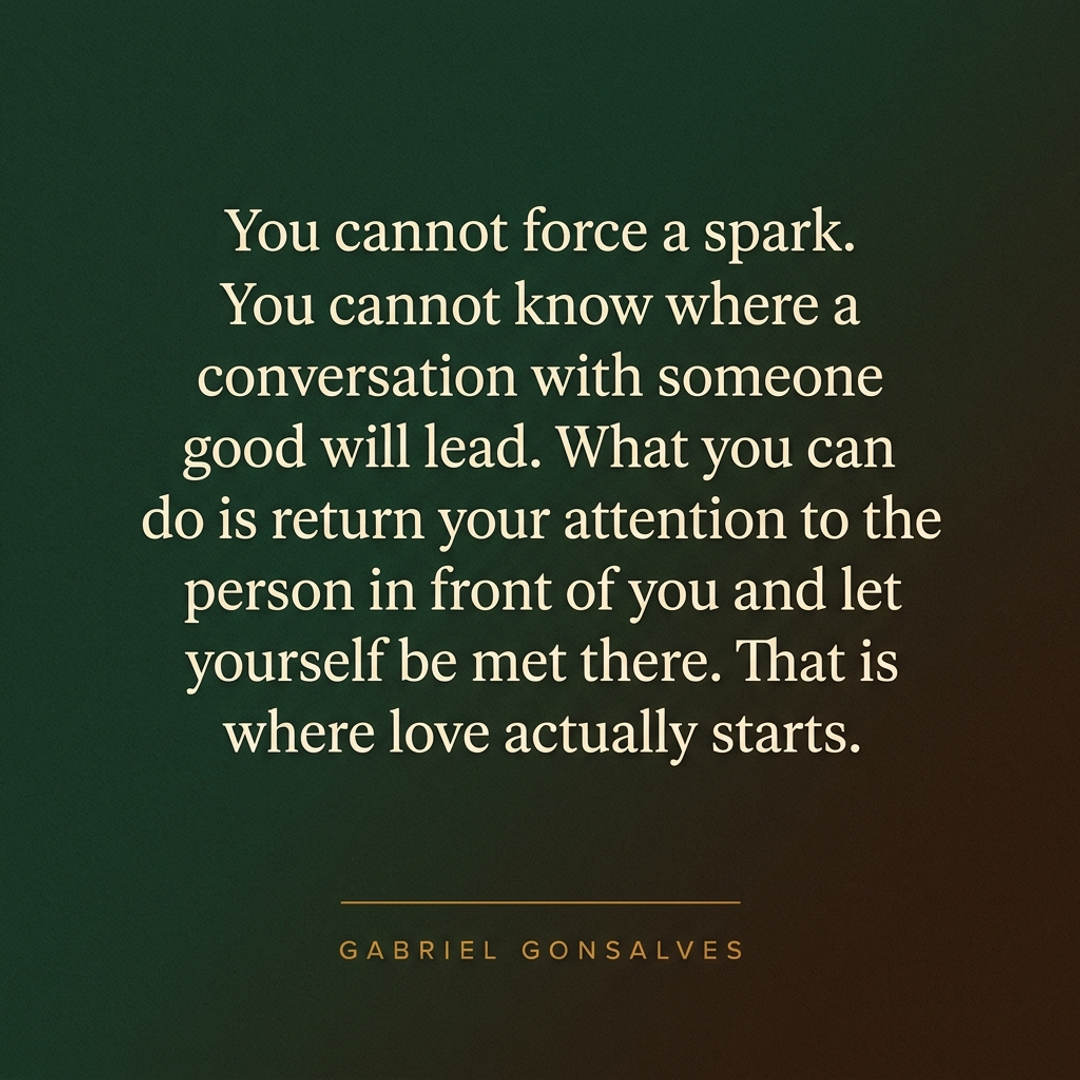
Think again of the person sitting across from you, and the moment before your phone lit up. You cannot force a spark, and you cannot know where that conversation will lead. But you can return your attention, look at the person in front of you, and allow yourself to be there for the moment that is actually happening.
Romantic love has not ended. The world around you is changing, and the ways it asks for your attention will continue to change. Even in a noisy world, you can make space to listen to your feeling heart and give your attention to the people you most care about.
In closing, I want to leave you with this question: What is your heart most longing for, and what might you be doing that keeps it away?
From my heart to yours,

PS. If this article resonated:
Explore different ways of working together: Whether you are just beginning to hear your heart’s call or ready to go all the way into the deepest work — there is a way for us to work together that meets you exactly where you are.
Subscribe to The Feeling Heart: Subscribe to my weekly newsletter with practical insights and spiritual teachings to help you navigate life’s challenges, deepen your heart connection, and live with greater purpose and joy.
Get the Heart Mastery Starter Kit – Free: The Heart Mastery Starter Kit is a free collection of resources to help you understand what Heart Mastery is, discover where you are on the journey, and experience what it feels like to finally come home to your heart.