

Have you ever reached a point where you had done everything you knew how to do, and it still wasn’t enough? You sought advice, followed through, prayed, and tried to stay hopeful. Yet the diagnosis hadn’t changed, the relationship was still breaking down, or the life you had worked so hard to build was coming apart.
In moments like these, the pain is often accompanied by a feeling of powerlessness. You keep looking for something else you can do, but you’re exhausted, and part of you is beginning to wonder whether any of your efforts will make a difference. “Why is this happening to me?” becomes a question you can’t seem to put down.
I know that place. It’s frightening to discover that your own strength can only take you so far, especially when you’ve spent much of your life believing it was up to you to make things happen. But I’ve also discovered that reaching this point can open us to a kind of help we hadn’t been willing to receive.
This is what I want to explore with you: how to invoke the spiritual will when your own willpower is no longer enough, so you can open your heart to God’s help and begin finding your way forward.
When My Own Strength Was No Longer Enough
When I was living in South Africa, several things happened that dismantled the life I thought I was building. I was robbed of my identification, money, and credit cards. Then I lost my job, and the following week, my mother passed away.
I blamed the man who had brought me there. He had hired me, canceled the project, and left me far from home without the work I had come to do. I had good reasons for feeling wronged, and I kept returning to them. But explaining what had been done to me wasn’t helping me find a way forward.
At some point, in the middle of all that pain, another possibility began to open. If God had brought me all the way here, perhaps something could still come from this experience. Even the documents that proved who I was had been taken. Maybe I was being asked to let go of who I thought I had to be and allow myself to be made new.
I was still grieving, and I had no idea what would happen next. What changed was that I became willing to surrender my idea of how my life was supposed to unfold. I couldn’t see the way forward, so I began asking God to guide me.
Until then, I had been looking at my circumstances mainly through what they had taken from me. As I surrendered, I became willing to ask what this experience might have to teach me. The losses still hurt, but I could begin listening for what might be awakening in me through them.
Looking back, I see how important that willingness was. I had reached a place where I could say, “I can’t do this on my own,” and mean it. For the first time in that situation, I was opening myself to help without insisting that I already knew what the answer should look like.
Why Trying Harder Is Not Always the Answer
Our human will serves an important purpose. It helps us get out of bed, keep our commitments, seek treatment, and take responsibility for our lives. There are things we need to do for ourselves, and walking a spiritual path doesn’t remove that responsibility.
The difficulty is that we often expect our efforts to give us control over the outcome. We can love someone deeply and still be unable to make them stay. We can take good care of our bodies and still become ill. We can make thoughtful plans and then find ourselves facing something we never imagined.
When that happens, many of us respond by pushing harder. We search for another solution, become stricter with ourselves, or lie awake trying to figure out what we’ve missed. Eventually, we may begin to feel that we’re failing simply because we haven’t been able to change what’s happening.
Dr. David R. Hawkins’ distinction between force and power helped me understand this struggle. Force tries to make something happen through pressure and control. Power becomes available as we align with a deeper source. Reading his explanation gave me language for something I had experienced in my own life.
It also helped me ask a different question. Was there another practical step I needed to take, or had I reached a point where I needed to stop trying to carry the whole situation by myself?
Opening to spiritual help can happen alongside every other kind of care you need. If your physical body needs medical treatment, give it that care. If you’re carrying grief or fear, give those feelings attention and support. Your prayer, meditation, and time in nature can be part of that same healing journey.
What Hawkins Means by the Spiritual Will
In Hawkins’ teachings, the spiritual will opens us to a power beyond the personal ego. Through his Map of Consciousness and kinesiology-based calibrations, he described different levels of consciousness and the power available as we move beyond the limitations of the individual self.
What speaks to me is that we don’t have to produce all the strength, wisdom, and love we need from our own resources. We can ask for help and become willing to receive it. That willingness gives our personal will a different purpose: we can use it to consent to being guided.
Of course, most of us begin by asking God for the outcome we want. We want the illness to go away, the relationship to heal, or the problem to be resolved. I understand that completely. But as we open to the spiritual will, we’re also being asked whether we can receive help in a way we haven’t imagined.
Hawkins described reaching the limits of his own resources and turning to God for help. He also recognized the importance of this surrender in Alcoholics Anonymous, where acknowledging the limits of personal will opens the door to a Higher Power and a community of support.
That surrender is followed by participation. A person in recovery still needs to show up, accept help, and practice a different way of living. The difference is that they are no longer depending entirely on the same isolated will that has already failed them.
This makes sense to me because it’s what I began to experience in South Africa. I still had decisions to make and a life to rebuild, but I was becoming willing to let God help me do it.
Opening to a Greater Field of Possibility
Hawkins used the language of attractor fields to describe how different levels of consciousness organize our experience. In his framework, invoking the spiritual will brings us into alignment with a higher field, where a different range of possibilities becomes available.
I understand this as opening to the love, wisdom, and power of God. Guidance can reach us through people, events, situations, and circumstances, but we have to become available to receive it. Sometimes that means accepting an offer of help. Sometimes it means recognizing that the direction we’ve been resisting may be the very direction we need to explore.
This is where getting out of the way becomes important. If I ask God to guide me but reject everything that doesn’t resemble my preferred answer, how much room have I actually made for guidance? I may still be trying to control the situation, only now I’m asking God to help me control it.
In South Africa, I had to loosen my attachment to the story I kept telling about what had happened. I could acknowledge that I had been wronged and still consider what was possible now. As I became willing to do that, I began to feel that I could participate in my life again.
For me, this is how we begin moving out of victimhood. We recognize that, even when we can’t change what happened, we still have a choice about how we meet it and whose help we’re willing to receive.
How to Invoke the Spiritual Will
For me, this begins in the heart. I can think about surrender for hours and still find myself trying to work out every detail. Bringing my attention to my heart helps me become present to what I’m feeling, including the fear and exhaustion I may have been trying to think my way around.
You don’t need perfect faith to begin, and you don’t have to wait until life becomes unbearable. Choose one situation where you’re tired of trying to control everything, and give yourself a few quiet minutes.
1. Come to your heart
Place a hand over the center of your chest and let your breathing become gentle and unhurried. Give yourself time to settle, without expecting a particular feeling.
Notice what’s there. You may feel fear, grief, anger, or simply how tired you’ve become. Whatever is present can be included in your prayer. You don’t have to get rid of it before asking for help.
2. Acknowledge what you can’t do alone
Name the situation and recognize the limit you’ve reached. You might say:
“I’ve done everything I know how to do. I can’t resolve this through my own will alone.”
Allow yourself to feel what it’s like to acknowledge that. You may have been carrying the belief that you should be able to handle this by yourself. Recognizing that you need help gives you somewhere else to turn.
3. Invite God’s help
If you’re unsure whether God exists, you can begin with that uncertainty. There’s no need to pretend to have a faith you don’t yet feel.
“God, if you’re there, please help me. I’m willing to receive your help.”
If you already have a relationship with God, speak from that relationship:
“Dear God, I’ve done everything I can. I place this situation in your hands. Help me open to your wisdom, your love, and your power. May your will be done.”
Use words that feel true to you. A simple request, offered sincerely, is enough to begin.
4. Offer the outcome, not only the problem
As you pray, notice whether you’re still holding on to a particular way the situation must be resolved. You can have hopes and preferences while allowing that there may be a way forward you can’t yet see.
You might say:
“This is what I’m hoping for, God. Help me release my need to decide how and when it must happen. I’m willing to be guided.”
You may find yourself returning to the same worry a few minutes later. When you notice that you’re trying to take control again, come back to your heart and offer it once more. This is something we learn through practice.
5. Listen, receive, and take the next step
Spend a few moments in silence. If it feels right, you can also invite understanding:
“Dear Holy Spirit, please help me understand what this experience has to teach me. Show me what needs care, what I’m being invited to release, and the next step I can take.”
Listen without demanding an immediate answer. There may be something you recognize, or you may simply feel ready to rest. You don’t have to find a lesson in the experience before you’re ready.
As you return to your day, remain open to help and willing to respond. A conversation may show you something you hadn’t considered. Someone may offer support, or you may recognize an action you’ve been avoiding.
Continue seeking appropriate care and doing what is yours to do. You can take the next responsible step while leaving the larger unfolding in God’s hands.
Learning to Surrender in Good Company
Opening to help can be difficult when you’ve spent years believing you have to manage everything yourself. I know how easily we can understand a teaching and then forget it when fear takes over. Having a place to return to, with people who are practicing alongside us, can make a real difference.
This is part of what we do in our Sacred Heart Meditations inside the Heart Mastery Circle. We come together to open our hearts, bring what we’re carrying into prayer, and deepen our relationship with God. If you’d welcome support in learning to live this way, you’re invited to join us.
Final Thoughts
When I look back on South Africa, I remember how much energy I spent explaining why my life had gone wrong. I also remember the opening that came when I became willing to be guided, even though I had no idea where that guidance would lead.
I still had to grieve, make decisions, and rebuild my life. But I began to experience those things with a sense that help was available and that I could ask for it. I didn’t have to know the whole way forward before taking the next step.
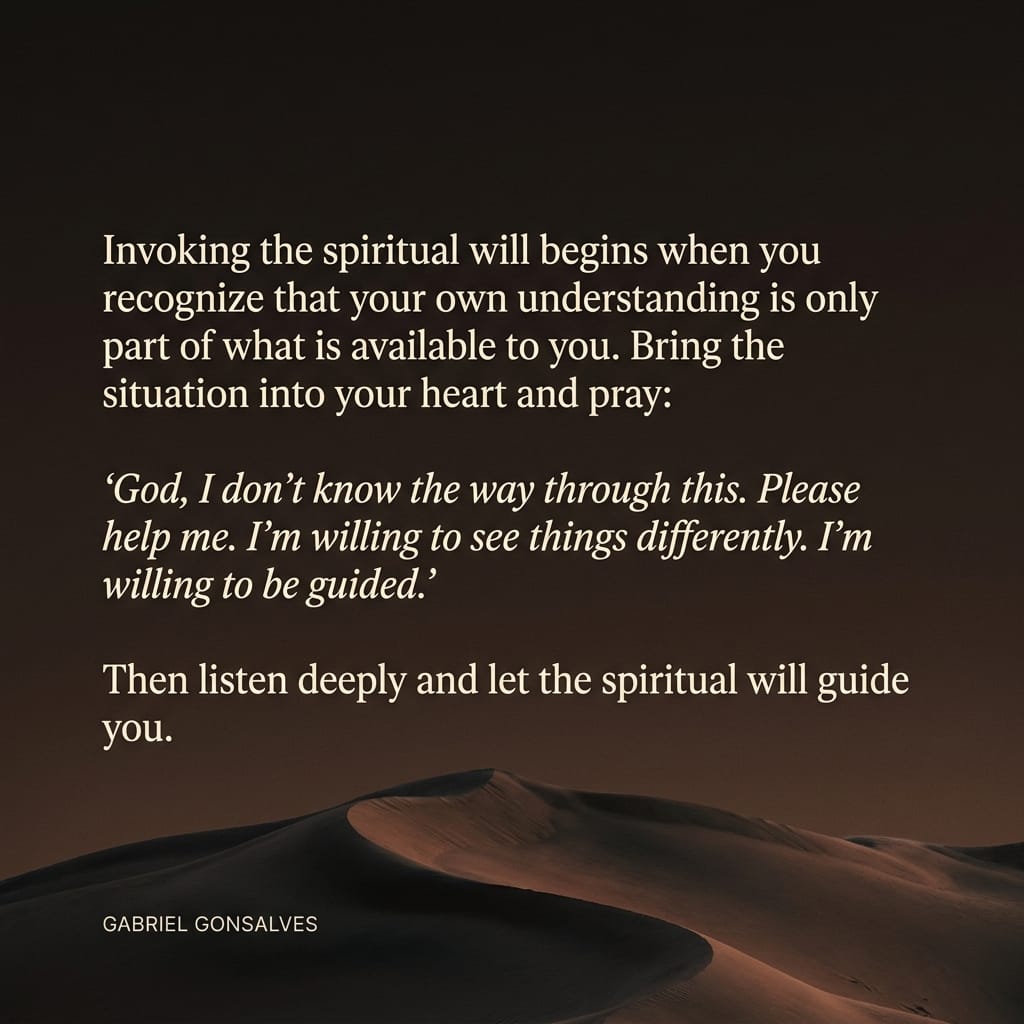
If there’s a situation in your life where your own will has taken you as far as it can, bring it into your heart for a moment. Let yourself acknowledge how much you’ve been carrying, and see whether you can open to this simple prayer: “God, I don’t know the way through this. Please help me. I’m willing to see things differently. I’m willing to be guided.”
Then listen deeply and let the spiritual will guide you.
From my heart to yours,

PS. If this article resonated:
Explore different ways of working together: Whether you are just beginning to hear your heart’s call or ready to go all the way into the deepest work — there is a way for us to work together that meets you exactly where you are.
Subscribe to The Feeling Heart: Subscribe to my weekly newsletter with practical insights and spiritual teachings to help you navigate life’s challenges, deepen your heart connection, and live with greater purpose and joy.
Get the Heart Mastery Starter Kit – Free: The Heart Mastery Starter Kit is a free collection of resources to help you understand what Heart Mastery is, discover where you are on the journey, and experience what it feels like to finally come home to your heart.