I was watching interviews with survivors of the Venezuelan earthquake when a young man said something I have not been able to forget.
He was only around twenty-four years old. During the earthquake, he fell through twelve stories with his wife and his two dogs. As he described the fall, the darkness, the dust, the rubble, and the terrifying uncertainty of whether they would survive, he said that the first thing he did was pray.
Later, when they asked him what advice he would give to others, his answer was simple: be grateful for what you have, because you never know when you may lose it. And do not wait until you are in trouble to ask for protection.
When Prayer Becomes Real
There are moments in life when prayer stops being a concept and becomes instinctive. You do not need someone to explain it to you. You do not need to have perfect theology. You do not need to know the right words. Something happens, the ground gives way, the mind reaches the end of what it can control, and the heart opens toward something greater.
That is what moved me so deeply about the earthquake survivor’s story. It was not only the tragedy of what he lived through. It was the clarity that came from it. When someone has passed that close to the edge of life and death, unnecessary things fall away. What remains is gratitude, love, and the awareness that life is far more fragile than we usually allow ourselves to remember.
His words stayed with me because they named something I have felt for a long time in my own spiritual practice, and in the prayer circles, song circles, healing spaces, and meditation gatherings I have had the privilege of facilitating over the years. Many of us wait until we are frightened before we pray.
We wait until the diagnosis, the breakup, the accident, the financial crisis, the sleepless night, the difficult conversation, or the moment when someone we love is in danger. Then, suddenly, prayer becomes real. The heart remembers what the mind had been too busy to notice.
But what if prayer was not only for emergencies? What if protection was not something you asked for only when trouble came close, but a relationship you cultivated every day? What if a prayer of protection meditation became a way of beginning the morning, entering the unknown, softening fear, and remembering that you are not alone?
What Is a Prayer of Protection?
A prayer of protection is a way of asking to be held, guided, strengthened, and surrounded by something greater than your fear. In the Christian tradition, that protection may be addressed to God, Christ, the Holy Spirit, angels, saints, or the presence of divine love itself. In other traditions, the language may be different, but the movement of the heart is often very similar. You are asking to be accompanied. You are asking to be guided. You are asking to be protected from harm, but also strengthened from within.
That distinction matters because a prayer of protection is not only a request to be spared from difficulty. Life does not always work that way. Good people still experience loss. Devoted people still face illness, uncertainty, heartbreak, and fear. Prayer is not a contract that guarantees nothing painful will ever happen.
At first, protection may sound like supplication: “Please protect me. Please help me. Please keep me safe.” There is nothing wrong with that. The frightened heart’s cry for help is holy. But as prayer deepens, protection also becomes realization. We begin to remember that divine presence is not somewhere far away, waiting to be convinced to come closer. It is already here.
For me, a prayer of protection is more intimate than that. It is a way of returning to relationship with God. It is a way of saying, “I do not want to walk through this life asleep, defended, and alone. I want to walk with my heart open. I want to remember the presence of love. I want to be guided by something deeper than my anxiety.”
The guided meditation I created for this article is inspired by the Breastplate of Saint Patrick, also known as the Lorica of Saint Patrick. It is one of the great Christian prayers of divine protection. The word lorica refers to a protective prayer, a kind of spiritual armor, not armor that hardens the heart, but armor that surrounds the heart with remembrance.
One of the most loved parts of the prayer invokes Christ in every direction:
Christ before me and behind me.
Christ above me and below me.
Christ on my right and on my left.
Christ within me and all around me.
I love this because it is not only a prayer you think. It is a prayer you can feel. It gives the body a map. It gives the heart a field. It invites you to sense protection not as an idea, but as a living presence surrounding you.
Before me: the path I am walking into. Behind me: the past I cannot change. Above me: the higher wisdom that guides me. Below me: the ground that holds me. On my right and on my left: the choices, relationships, and responsibilities on either side of me. Within me: the sanctuary of the heart. Around me: the unseen field of grace.
This is important. The prayer does not create a wall between you and the world. It creates a field. A wall comes from fear. A field comes from presence. A wall says, “Keep everything away from me.” A field says, “Let me move through life surrounded by love, guided by wisdom, and rooted in God.”
This is why a prayer of protection can be so helpful when you feel worried, vulnerable, spiritually disconnected, or unsure of what comes next. It gives your mind sacred words to rest on. It gives your breath a rhythm. It gives your feeling heart a doorway back into trust.
Does Prayer Actually Work?
When I was around seventeen, just after graduating from high school, I traveled with my father to Canada. He had come to Connecticut for my graduation, and afterward we visited one of his close friends, a psychiatrist named Dr. Norman Raskin.
My father was a deeply spiritual man. He prayed every night. From the time we were little, he taught us to pray too. But prayer, for him, was never only about asking for things for himself. He prayed for the world. He prayed for his clients. He prayed for family members, friends, people who were sick, people who had died, and people who were going through difficult times.
Prayer was part of how he loved.
I remember being surprised when, during that visit, he asked Dr. Raskin something like, “Norman, do you believe in prayer? Does prayer actually work?” I do not remember the full conversation, but I remember his exact response. He said, “Joe, prayer works only for those who believe in prayer.”
At seventeen, I do not think I fully understood what he meant. Part of me probably heard it as a psychological answer, as if prayer only worked because someone believed it worked. But the older I get, the more I return to that moment with a different understanding.
Maybe the power of prayer is not only in the words themselves. Maybe the words are the doorway. Maybe what gives prayer its power is the faith, intention, feeling, devotion, surrender, and sincerity moving through those words. Maybe prayer works because it changes the one who prays. It gathers the scattered mind. It softens the defended heart. It opens a person to grace, guidance, and courage.
Jesus said, “According to your faith, let it be done to you.” In the Gospels, there is also the story of the woman who touched the hem of his garment, believing that if she could only touch him, she would be healed. It was not only the physical touch that mattered. It was the faith moving through the touch.
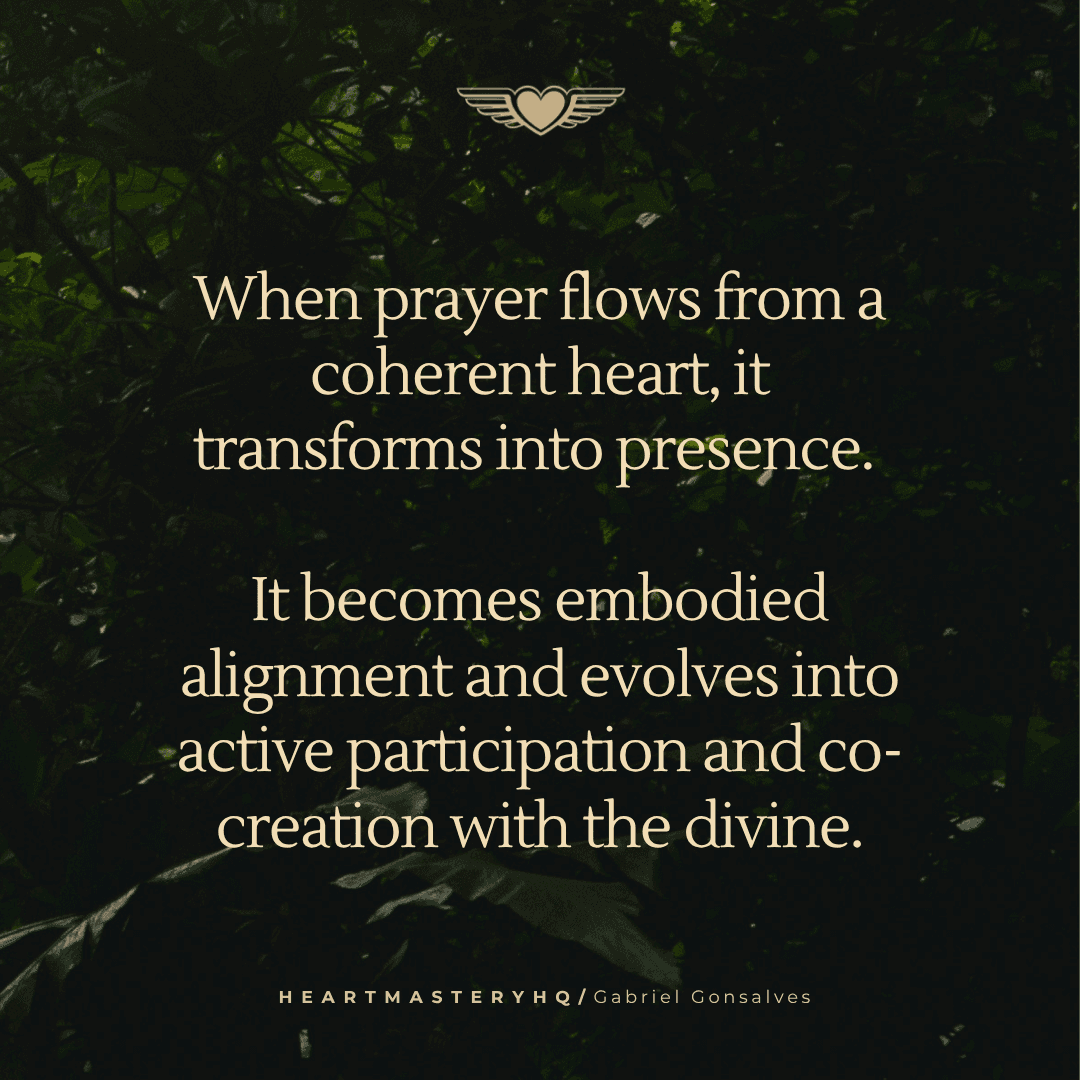
This is how I have come to understand prayer more and more. Prayer is not magic words spoken from the head. Prayer is a movement of the heart. And when prayer flows from a coherent heart, a heart softened by love, gratitude, faith, devotion, or surrender, it transforms into presence. It becomes embodied alignment, active participation, and co-creation with the divine.
Through the heart, prayer is no longer only something we say or do — it is something we become. This is what it means to pray without ceasing: to let the frequency of the heart become the living prayer.
The Science of Heart Coherence and Prayer
Can science prove that God hears your prayer? That is not the question science is built to answer. But science can help us understand what happens in the body when you pray, breathe, meditate, focus your attention, and activate sincere feelings such as love, gratitude, compassion, and appreciation.
This is where heart coherence becomes such a powerful companion to prayer. Heart coherence is a state of greater harmony between the heart, brain, nervous system, and emotions. In practical terms, it often begins by slowing the breath, placing attention in the heart area, and activating a renewing feeling. When you do this, the body often begins to settle. The breath becomes steadier. The mind becomes less scattered. The nervous system receives a signal of safety.
In my own practice, and in the spaces I facilitate, I have seen how different prayer feels when it is joined with the body. Many people pray from the mind, and there is nothing wrong with that. But when you bring your attention to the heart, breathe slowly, and allow a sincere feeling to arise, the prayer begins to move through more of you. It is no longer only a sentence. It becomes embodied.
The body needs time to register safety. This is why we slow down. This is why we breathe through the heart. This is why we soften the jaw, the shoulders, the eyes, and the belly. We are not only thinking peaceful thoughts. We are giving the nervous system enough time to receive the message: I am held.
This is why I created this prayer of protection meditation as a heart coherence practice. The breath helps regulate the body. The words help focus the mind. The feeling helps open the heart. The prayer helps orient the soul.
Science can describe part of this. It can speak about the nervous system, emotional regulation, attention, breath, and coherence. Spiritual wisdom speaks about the rest: grace, faith, surrender, presence, and the mystery of being held by something greater than yourself. For me, these two are not in conflict. The science gives language to the doorway. The prayer invites you to walk through it.
How to Practice This Prayer of Protection
You can use this prayer of protection whenever you feel afraid, uncertain, vulnerable, or in need of guidance. You can also practice it when nothing is wrong. That may be the most important part.
If you only pray when you are afraid, prayer becomes associated with crisis. But when you pray in the morning, before sleep, before a conversation, before traveling, before creating, before serving, or before entering the unknown, prayer becomes a relationship. It becomes a rhythm. It becomes a way of living close to the heart.
Here is a simple way to practice. Place one or both hands over your heart. Let your shoulders soften. Let your jaw relax. Take a slow breath in and a slow breath out. Imagine that your breath is moving in and out through the center of your chest.
Then bring to mind a sincere feeling. It could be love. Gratitude. Faith. Devotion. Appreciation. If those feel far away, think of someone you love, a moment of grace, or a time when you felt protected.
From there, repeat the prayer slowly:
Christ before me and behind me.
Christ above me and below me.
Christ on my right and on my left.
Christ within me and all around me.
Do not rush the words. Let the words become breath. Let each line become a slow exhale into the body. Let each breath become a feeling. Let each feeling become a field around you.
Afterward, pause for a few moments. Notice your body. Notice your heart. Notice the space around you. You do not have to make anything happen. You are simply giving yourself time to receive.
How often should you practice? As often as it feels sincere. You might practice this prayer of protection meditation for three minutes every morning. You might use it before stepping into a difficult conversation. You might pray it when someone you love is suffering and you do not know what else to do. You might return to it at night, placing your day into the hands of God before you sleep.
The important thing is not the number of repetitions. The important thing is the sincerity of the heart.
There is another adapted beautiful part of the Breastplate of Saint Patrick that extends the prayer into our relationships:
Christ in every heart that thinks of me.
Christ in every mouth that speaks of me.
Christ in everyone who sees me and hears me.
Christ in everyone I meet.
I find this especially meaningful before conversations, teaching, writing, serving, or entering a situation where I feel exposed. It is not a prayer to control how others perceive us. It is a prayer that Christ, love, and grace become the meeting place between us. May the heart of Christ be in what I say. May the heart of Christ be in how I am received. May the heart of Christ be in the space between us.
What If I’m Not Christian?
This is a Christ-centered meditation, and I want to be clear and respectful about that. The prayer is inspired by a Christian tradition. The language of Christ is not decorative here. It is central to the meditation. For those who have a relationship with Christ, or feel drawn to Christ as a presence of love, protection, mercy, and light, the prayer can be deeply meaningful.
At the same time, I know that many people who come to my work are spiritually sincere but not necessarily Christian. Some come from other traditions. Some have been hurt by religion. Some feel connected to Jesus but not to institutional Christianity. Some relate more naturally to Love, God, Source, the Divine, or the intelligence of the heart.
Here I feel it is important to make a distinction that is often forgotten: Christ was not Christian, and he did not come to establish a religion. He came to teach a pathway to God through love. In a similar way, the Buddha did not come to create a belief system for people to defend. He came to teach a pathway of awakening through compassion, kindness, and direct realization.
The word Christ is also a title. It means the anointed one. In the same way, Buddha is a title that means the awakened one. So when I pray, “Christ before me and behind me,” I am invoking the presence of one who awakened to God’s infinite love and became that love in human form. I am asking that love, that awakened presence, that anointed consciousness, to surround and guide me.
If the word Christ does not feel available to you, I would invite you to listen honestly. You do not need to force language that does not feel true in your body. Prayer must be sincere. Otherwise it becomes performance.
Because ultimately, God is love. And if the word God or Christ creates distance for you, you can simply say Love. Love before me and behind me. Love above me and below me. Love on my right and on my left. Love within me and all around me. Love is the energy that nurtures, cares for, and supports all of life.
I would only say this: adapt with reverence. Do not flatten the prayer into something generic. Let it keep its sacredness. Let it ask something of you. Let it open you to humility, gratitude, and trust.
The deeper invitation is not to believe exactly what I believe. The deeper invitation is to let your heart become available to protection, guidance, and love.
Final Thoughts
The young earthquake survivor’s words still echo in me: do not wait until you are in trouble to ask for protection.
I think this is the heart of the whole teaching. Not because life should be lived in fear, but because life becomes more beautiful when it is lived in relationship with the sacred.
Prayer does not have to be dramatic. It does not have to be perfect. It does not have to sound impressive. Sometimes the most powerful prayer is the simplest one whispered from your feeling heart when you finally stop trying to carry everything alone.
What would change if you prayed before the crisis? What would change if protection became a daily rhythm rather than an emergency request? What would change if, instead of waiting until fear took over, you began each day by remembering that you are held?
From my heart to yours,

PS. If this article resonated:
Explore different ways of working together: Whether you are just beginning to hear your heart’s call or ready to go all the way into the deepest work — there is a way for us to work together that meets you exactly where you are.
Subscribe to The Feeling Heart: Subscribe to my weekly newsletter with practical insights and spiritual teachings to help you navigate life’s challenges, deepen your heart connection, and live with greater purpose and joy.
Get the Heart Mastery Starter Kit – Free: The Heart Mastery Starter Kit is a free collection of resources to help you understand what Heart Mastery is, discover where you are on the journey, and experience what it feels like to finally come home to your heart.